

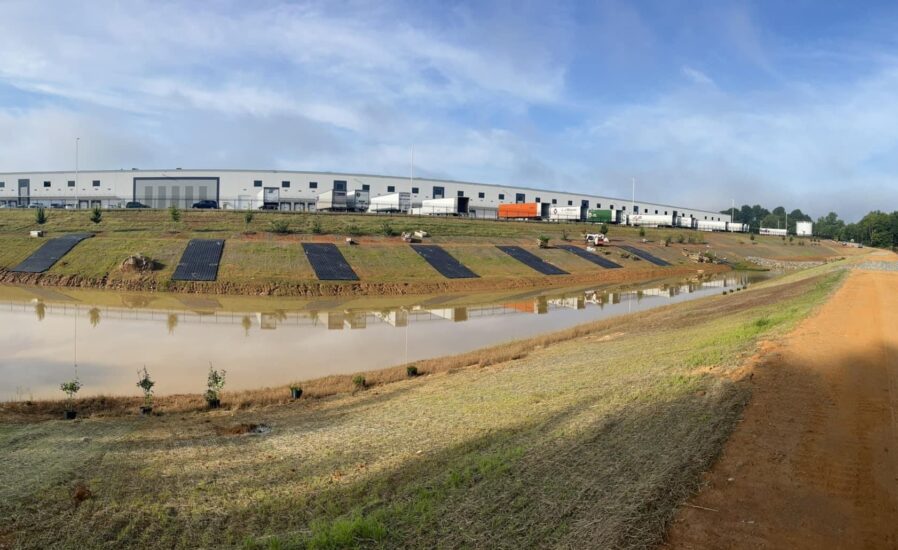
Stormwater management is one of the most consequential, and most frequently overlooked, responsibilities for commercial and industrial property owners in Greensboro. Between the City of Greensboro’s own stormwater management requirements, NCDEQ’s statewide regulatory framework, and federal NPDES permit obligations, the compliance landscape is real and consequential. Failing to properly maintain your stormwater control measures can result in regulatory violations, fines, and liability for environmental damage.
Beyond compliance, poorly managed stormwater creates direct, expensive problems for commercial properties: flooded parking lots, eroded landscapes, damaged building foundations, and deteriorating hardscapes. Getting stormwater right protects your property as much as it protects the environment.
Here’s what Greensboro commercial property managers need to understand about their stormwater obligations, and how proactive management makes compliance manageable.
TLDR
- Greensboro is a Phase I NPDES community with rigorous stormwater compliance requirements
- Commercial properties must maintain stormwater control measures (SCMs) per NCDEQ and City rules
- SCM types include detention ponds, bioswales, bioretention areas, and underground detention systems
- Deferred SCM maintenance leads to system failure, regulatory violations, and costly corrective action
- Industrial facilities may also carry NPDES permit obligations requiring SWPPPs and ongoing monitoring
- North American Lawn & Landscape provides proactive SCM management for Greensboro commercial properties
How Greensboro Regulates Commercial Stormwater
Greensboro operates under a comprehensive stormwater management program that addresses both water quality and drainage infrastructure. The City is a Phase I NPDES community, one of relatively few in North Carolina, which means it operates under some of the more rigorous stormwater regulatory requirements in the state. Commercial properties in Greensboro are subject to both state NCDEQ stormwater rules and the City’s own Stormwater Management Manual, which governs the design, installation, and ongoing maintenance of stormwater control measures on developed properties.
The City also assesses a monthly stormwater utility fee on all properties within city limits, calculated based on impervious surface area. Properties with qualifying stormwater control measures may be eligible for credits that reduce that fee, another financial reason to ensure your systems are properly designed and maintained.
Greensboro’s watershed protection requirements add another layer of complexity. The City’s watersheds, including those feeding Lake Brandt, Lake Higgins, and Lake Townsend, are subject to strict water supply watershed rules that limit impervious surface coverage and require engineered stormwater solutions for higher-density development. Properties in these watersheds have specific obligations around impervious surface calculations, riparian buffers, and stormwater treatment.
What Are Stormwater Control Measures (SCMs)?
Stormwater control measures, or SCMs, are the engineered and vegetated systems designed to capture, treat, slow, and manage runoff from commercial properties. If your property was developed or redeveloped after certain thresholds, it very likely has SCMs on site. Common types include wet detention ponds and dry detention basins, bioretention areas and rain gardens, vegetated swales and filter strips, permeable pavement systems, and underground detention systems.
Each of these systems requires ongoing maintenance to function as designed. Vegetation must be managed, inlets must be kept clear, erosion must be addressed, and structural elements must be inspected and repaired as needed. Greensboro’s stormwater manual includes specific inspection and maintenance checklists for each type of SCM, and compliance documentation is typically required.
The Consequences of Deferred SCM Maintenance
Stormwater control measures that aren’t properly maintained don’t just fail quietly. Detention ponds with overgrown vegetation lose capacity and may no longer meet their permitted design requirements. Clogged inlets cause water to bypass the system entirely, increasing downstream flooding risk. Eroded embankments can compromise structural integrity. Bioretention areas that have become compacted or overgrown lose their ability to filter and infiltrate runoff effectively.
When inspectors identify non-compliant SCMs, the corrective action timeline can be short and the costs significant. More importantly, a system that isn’t functioning as designed isn’t protecting your property or the downstream environment, which is the whole point.
NPDES Permit Requirements for Industrial Properties
Industrial facilities in Greensboro with stormwater discharges to surface waters may be subject to NPDES industrial stormwater permits. These permits typically require a Stormwater Pollution Prevention Plan (SWPPP), routine site inspections, monitoring of stormwater discharge quality, and annual reporting. NPDES industrial general permits in North Carolina operate on five-year cycles, and facilities must maintain compliance throughout the permit period.
For industrial property managers, stormwater compliance is an ongoing operational responsibility, not a one-time permitting exercise. Having a qualified landscape and stormwater management partner familiar with NCDEQ requirements can make that ongoing compliance significantly more manageable.
A Proactive Approach to SCM Maintenance
The most effective way to manage stormwater compliance is proactively, establishing a regular inspection and maintenance schedule that keeps systems performing as designed year-round, rather than responding to problems after they’ve developed or after an inspection has identified deficiencies.
A proactive SCM maintenance program for a commercial property in Greensboro typically includes routine inspections following significant rainfall events and on a scheduled quarterly or semi-annual basis, vegetation management in and around detention ponds, bioswales, and filter strips, inlet and outlet structure clearing to maintain hydraulic function, erosion identification and repair before minor issues become structural problems, documentation of maintenance activities to support compliance reporting, and coordination with NCDEQ and city requirements as they evolve.
North American Lawn & Landscape: Stormwater Management in Greensboro
North American Lawn & Landscape has been serving commercial and industrial properties across Greensboro for over 40 years. Our stormwater management services are integrated with our broader landscape program, meaning the team that manages your grounds understands your drainage systems, your plant material, and your compliance obligations together, not in isolation.
We work with property managers, facility directors, and developers across the Piedmont to keep stormwater control measures functioning, properties protected, and compliance obligations met. Whether you’re managing an existing SCM program, facing an upcoming inspection, or planning new development with stormwater implications, we’re here to help.
Request a proposal today and let’s talk about keeping your Greensboro property compliant and protected.